

How to Get Your Sex Drive Back After Menopause
Share
By the NUUD team
The cruelty of menopause isn't just the hot flashes. It's that the body you've known for forty or fifty years suddenly changes the rules — and the one thing nobody warns you about, the one most women don't bring up even with their closest friends, is what happens to desire. The interest fades. The body stops responding the way it used to. Sex becomes uncomfortable, or distant, or a thing that requires a whole project to set up. And because it's menopause, everyone around you treats it as expected. As if you should have planned for this. As if you should be okay with it being over.
You don't have to be. The loss of desire in menopause is real, it's biological, and it's one of the most addressable parts of the whole transition — provided you know which levers actually matter and which are just marketing.
This is a guide for getting your sex drive back after menopause. It's honest about what the body is doing, what the medical system can offer, and what a plant-based approach can add on top. We make libido supplements for women at NUUD, so take our view accordingly. We'll be clear when we're pointing at one of our products.
The short answer
- Menopausal libido drop is near-universal: estrogen falls 80–90% from premenopausal levels and testosterone has already declined ~50% between a woman's 20s and 40s, with both continuing downward through the transition.
- It's two problems at once — the wanting (a testosterone, dopamine, and stress problem) and the physical response (vaginal dryness, thinning tissue, painful sex driven by estrogen loss). Fixing one without the other is the most common trap.
- Medical options worth discussing with a menopause-literate clinician: low-dose vaginal estrogen for tissue comfort, systemic HRT (transdermal estradiol + progesterone) for whole-body symptoms, and low-dose off-label testosterone for desire that persists after the baseline is restored.
- The plant ingredients with real human research in menopausal women are KSM-66 ashwagandha, maca, fenugreek (Libifem extract), and tribulus terrestris — with functional mushrooms (cordyceps, reishi) as a stack-amplifier.
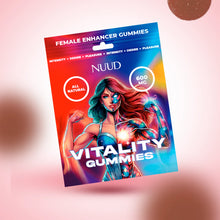
- If you want a low-stakes starting point that combines several of those at meaningful doses, our NUUD Libido Gummies for Women stack KSM-66 ashwagandha, maca, and a proprietary mushroom complex in one gummy taken 30–60 minutes before.
What menopause actually does to desire
Menopause isn't one change. It's three hormones moving at different rates, and each one hits desire differently.
Estrogen drops sharply — often 80–90% from premenopausal levels. That drop is what drives the classic symptoms: hot flashes, sleep disruption, mood changes, and the physical thinning and drying of vaginal tissue (the Menopause Society now refers to this as the genitourinary syndrome of menopause, or GSM). When sex becomes physically uncomfortable, the brain does a quiet calculation — uncomfortable, therefore not worth it — and desire follows.
Testosterone drops too, but more gradually. Women produce testosterone in the ovaries and adrenal glands, and levels decline roughly 50% between a woman's 20s and her 40s, then continue downward through menopause. Testosterone is one of the most direct drivers of female desire, and the decline is one of the most under-discussed parts of the whole transition.
DHEA — the adrenal hormone that serves as a precursor to both estrogen and testosterone — drops steadily from the 30s onward and is often at a fraction of peak levels by menopause.
The combined effect is a body with less of the raw material it needs to produce wanting. This is not a character change. It's a chemistry change, and chemistry responds to inputs.
The two halves of the problem
The reason menopause-related low libido is so hard to talk about in simple terms is that it's really two separate problems that usually happen together.
The first half is the wanting itself — the desire that used to arrive on its own and now doesn't. This is mostly a testosterone/dopamine/baseline-stress problem, and it responds to the interventions below.
The second half is the body's physical response — vaginal dryness, thinning tissue, discomfort or pain with sex, slower arousal, fewer or less intense orgasms. This is mostly an estrogen problem, and it responds to a different (and often more medical) set of interventions.
Fixing one without the other is a common trap. Supplements for desire won't solve painful sex; topical estrogen won't make you want it. Most women need to address both halves to actually enjoy what they're bringing back.
What the medical path offers (and what it doesn't)
There's more modern medicine available for menopausal libido than a lot of women have been told. Not all of it is right for every woman, and a knowledgeable menopause practitioner is worth more than any article.
Systemic hormone replacement therapy (HRT)
Modern HRT — typically transdermal estradiol plus progesterone (if you still have your uterus) — is more nuanced and more individualized than the generation of HRT that was given up on after the 2002 Women's Health Initiative trial was reported. The Menopause Society (NAMS) updated its position statement in 2022 to affirm that for most healthy women under 60 or within 10 years of menopause onset, the benefits of HRT typically outweigh the risks (Menopause, 2022). HRT isn't primarily a libido treatment, but by addressing hot flashes, sleep, mood, and vaginal changes at once, it often brings desire back as a side effect of restoring the baseline. If breast cancer treatment is what brought menopause on, sex drive after breast cancer treatment covers what 36 studies of survivors found.
Vaginal estrogen (topical)
Low-dose vaginal estrogen — cream, tablet, or ring — addresses GSM directly and has an excellent safety profile. It treats the physical half of the problem (dryness, thinning, pain) and is often appropriate even for women who can't or don't want systemic HRT. This is the single highest-leverage intervention for women for whom sex has become physically uncomfortable. If that's you, ask.
DHEA (prasterone)
Vaginal DHEA is FDA-approved for GSM and also addresses the local tissue changes of menopause. It's an option for women who want local hormone support without systemic estrogen.
Testosterone for women
A 2019 global consensus position statement — endorsed by the Menopause Society, the International Menopause Society, and several other major bodies — concluded that testosterone therapy in physiological (female-range) doses can improve sexual desire, arousal, and orgasm in postmenopausal women with low desire that is causing them distress (Davis et al., The Lancet Diabetes & Endocrinology, PMID: 31353194). There is no FDA-approved testosterone product for women in the U.S. — the prescription has to be written off-label, typically using a small fraction of a male dose — but it's a real option with a real evidence base when prescribed by a practitioner who knows what they're doing.
Non-hormonal prescriptions
Two non-hormonal medications are specifically approved for women with low desire: flibanserin (taken daily) and bremelanotide (as-needed injection). Both are approved only for premenopausal women, though they get used off-label post-menopause. Both have modest efficacy data and notable side-effect profiles. They exist; they're not the first-line answer for most women.
What actually helps on the non-prescription side
The non-medical interventions below work alongside — not instead of — a conversation with a menopause-literate practitioner. If painful sex or severe GSM is in the picture, address that first. Everything below works best on a baseline where sex is physically comfortable.
Sleep — still the biggest lever
Menopause often disrupts sleep in the same season it disrupts desire, and the two reinforce each other. Hot flashes, night sweats, and middle-of-the-night waking produce chronic short sleep, which suppresses testosterone (in both sexes), raises cortisol, and flattens mood. Fixing sleep — whether through HRT, targeted temperature regulation, magnesium, or a bedtime shift — is often the single change that moves the most.
Strength training
Resistance training twice a week does three things at once: lowers cortisol, supports testosterone, and preserves the lean body composition that otherwise drifts after menopause. Every additional year of strength training accumulated past menopause correlates with better metabolic, musculoskeletal, and sexual outcomes. You don't need a program designed for athletes. You need basic compound movements, twice a week, for the rest of your life.
The plant ingredients with real human research in menopausal women
- KSM-66 ashwagandha. The 2015 randomized, double-blind, placebo-controlled trial that established KSM-66 for female sexual function enrolled women aged 21–50 and found 600 mg/day improved arousal, lubrication, and satisfaction over 8 weeks (Dongre et al., BioMed Research International, PMID: 26504795). A separate 2021 trial in perimenopausal women found KSM-66 improved menopause-specific quality of life and hormone markers over 8 weeks (Gopal et al., Journal of Obstetrics and Gynaecology Research, PMID: 33831284). Ashwagandha works both the cortisol side and the hormone side at once, which is why it's the backbone of most honest formulas for this stage of life.
- Maca root. A 2008 double-blind, placebo-controlled trial of 14 postmenopausal women found 3.5 g/day of maca significantly reduced anxiety and depression scores and improved sexual dysfunction versus placebo over 6 weeks (Brooks et al., Menopause, PMID: 18784609). A 2006 trial in postmenopausal women reported similar improvements in sexual function and mood (Meissner et al., International Journal of Biomedical Science, PMID: 23675005). Maca works on the desire side without shifting estrogen or testosterone levels directly — meaning it's usable alongside HRT or on its own.
- Fenugreek (Libifem extract). A 2015 randomized trial in 80 menstruating women found 600 mg/day of Libifem fenugreek significantly increased free testosterone and improved sexual desire and arousal versus placebo (Rao et al., Phytotherapy Research, PMID: 25914334). A 2017 follow-up in postmenopausal women specifically found Libifem improved sexual function and quality of life over 12 weeks (Steels et al., PMID: 28707431).
- Tribulus terrestris. A 2017 randomized trial in 45 menopausal women found tribulus significantly improved desire, arousal, lubrication, orgasm, and satisfaction scores versus placebo over 90 days (Kamenov et al., Maturitas, PMID: 28364812). Evidence in premenopausal women is mixed, but the menopausal-specific data is strong.
- Functional mushrooms (cordyceps and reishi). Smaller research base than the four above, mostly preclinical. The reason they matter in the menopausal stack is that most women in this age range have already tried maca or ashwagandha in isolation and didn't feel enough. The mushroom complex is often the variable that changes the result when it's combined with the better-studied herbs.
Where NUUD fits
We made our libido gummies for women and libido capsules for women for the woman this article is for: someone in or past the transition who wants something plant-based, non-prescription, and fast enough to matter on the night she's trying to have. One gummy or one capsule, 30 to 60 minutes before. No daily routine required. No 14-day wait. Designed for the evening you mean to have, not the routine you're building.
Our formulas combine Tribulus Terrestris, Muira Puama, and the proprietary NUUD Mushroom Complex — the three ingredient categories that our menopausal and postmenopausal customers most often tell us made the difference. If you're already on HRT or vaginal estrogen, these formulas are compatible with both (though as always, run any new supplement by your prescribing doctor). For couples who want to bring something home that works for both partners at once, our couples intimacy bundle pairs a women's and men's supply.
"I'm 58 and I felt like myself again. I wasn't sure that was still possible."
— Verified NUUD customer review
The honest summary
Menopause changes the chemistry, not the capacity. Most women who get their sex drive back after menopause do it by addressing both halves of the problem at once — the physical (vaginal estrogen or systemic HRT, if indicated) and the desire (sleep, strength training, and the plant ingredients above, layered on a healthy baseline). There is no single answer, and there's also no reason to accept the loss as permanent.
The "again" is still available. It just takes a different set of inputs than it did at thirty.
When to see a doctor
See a menopause-literate practitioner (a certified menopause practitioner through the Menopause Society, or a gynecologist with a menopause focus) if:
- Sex has become physically uncomfortable or painful
- You have hot flashes, night sweats, or sleep disruption interfering with daily life
- You want to discuss HRT, vaginal estrogen, or off-label testosterone
- The libido change is accompanied by mood collapse, severe fatigue, or cognitive changes
- Non-prescription interventions haven't moved the needle after 8–12 weeks
What to try first
- Talk to a menopause-trained clinician about hormones — vaginal estrogen, MHT, low-dose testosterone are all valid options.
- Address sleep, stress, and pelvic floor — these compound the hormonal shift.
- Rebuild ritual with your partner — responsive desire often returns through context, not spontaneous.
- Trial maca or ashwagandha for 4–8 weeks (non-hormonal, well-tolerated).
- Layer a stacked daily formula like NUUD Libido Gummies for Women if single-ingredient trials helped but plateaued.
Medical and natural options at a glance
| Approach | What it does | Onset | Best for |
|---|---|---|---|
| Vaginal estrogen (Rx) | Restores tissue comfort + lubrication | 2–4 weeks | Pain or dryness driving avoidance |
| Systemic MHT (Rx) | Hormones across the body — mood, sleep, libido | 4–12 weeks | Multiple menopause symptoms together |
| Low-dose testosterone (Rx, off-label) | Targets desire directly | 4–8 weeks | Persistent low desire after MHT |
| Maca (natural) | Mood + desire support, non-hormonal | 2–6 weeks daily | SSRI-related libido drop, hormone-cautious |
| NUUD Libido Gummies for Women | Stacked natural blend (maca + mushroom complex) | 30–60 min acute + cumulative | Low-pressure starting point alongside lifestyle |
FAQ
Why does menopause cause low libido?
Three hormones drop during menopause — estrogen, testosterone, and DHEA — and each affects desire differently. Estrogen loss drives physical changes (vaginal dryness, slower arousal). Testosterone loss affects the wanting itself. Add the sleep disruption and mood changes of the transition, and the cumulative effect is a baseline with less of the raw material desire needs.
How can I get my sex drive back after menopause?
Most women benefit from addressing two halves at once: the physical (vaginal estrogen or systemic HRT if indicated) and the desire (sleep, strength training, and plant ingredients with real research). The ingredients with the strongest human data for menopausal women are KSM-66 ashwagandha, maca, fenugreek Libifem, and tribulus terrestris.
Does HRT improve libido?
Indirectly, usually yes. Systemic HRT addresses hot flashes, sleep, mood, and vaginal changes — and when the baseline is restored, desire often returns. HRT is not primarily a libido treatment, but for many women it removes the reasons desire had disappeared.
Can I take a libido supplement with HRT or vaginal estrogen?
Most well-formulated plant-based libido supplements are compatible with HRT and vaginal estrogen. Ashwagandha, maca, and functional mushrooms don't interact with hormone therapy in any clinically meaningful way in the published literature. Always run a new supplement by your prescribing doctor, especially if you take multiple medications.
What's the best supplement for libido after menopause?
No single ingredient wins for every woman. The ingredients with the strongest human research in menopausal women specifically are KSM-66 ashwagandha (Dongre 2015, Gopal 2021), maca (Brooks 2008), fenugreek Libifem (Rao 2015, Steels 2016), and tribulus (Kamenov 2017). Formulas that combine several at meaningful doses tend to outperform single-ingredient products.
Is painful sex during menopause fixable?
Yes, in most cases. Low-dose vaginal estrogen (cream, tablet, or ring) directly treats the tissue thinning and dryness that cause menopausal painful sex, and it has an excellent safety profile. Vaginal DHEA is another option. This is a conversation worth having with a menopause-literate practitioner rather than living with the discomfort.
How long does it take to restore libido after menopause?
Physical changes from vaginal estrogen can improve within 4 to 8 weeks. Systemic HRT shifts usually show up in 8 to 12 weeks. Plant-based supplementation typically shows effects in 2 to 8 weeks for daily products and same-day for fast-acting formulas. Give any single intervention at least 8 weeks before deciding it isn't working.
Disclosure: NUUD Pleasures sells libido supplements for women. This post reflects our perspective as a brand in the category.
FDA disclaimer: These statements have not been evaluated by the Food and Drug Administration. This product is not intended to diagnose, treat, cure, or prevent any disease. Consult your healthcare provider before starting any supplement, especially if you are pregnant, nursing, taking medication, or managing a medical condition.
Many women in this stage want something they can take on their own terms. NUUD's libido supplements for women are plant-based and hormone-free, with a 60-minute onset.
For a plant-based option built for this stage of life, see NUUD's supplements for libido over 40.
Keep Reading
For the full evidence review of what supports female desire — especially in midlife and menopause — see our guide to aphrodisiacs that actually work. For the adaptogen and mushroom research specifically, read mushrooms for libido and sex drive. For couples navigating long-term partnership through this transition, the Coolidge Effect explains the biology and what to do about it.
Shop NUUD for Women
- NUUD Libido Gummies for Women — a natural female libido enhancer; on-demand, lasts up to 3 days per dose
- Vitality Libido Support Capsules for Women — our most potent format, up to 6 days of duration
- Watermelon Lime Intimacy Drink — fast-absorbing powder for same-evening use
