

Why Weight Loss and Lingerie Don't Fix Low Libido (It's Not About How You Look)
Share
She lost 70 pounds. Then she booked a boudoir shoot, bought lingerie, and handed her husband the album. He looked at every photo. He still doesn't initiate. She posted about it on Reddit this week wondering what she's doing wrong, concluding she must not be attractive enough yet. A second post the same day: a couple who lost 200 pounds combined, and the wife's libido is exactly where it was before. Their conclusion: "I must be the problem."
Neither of them is the problem. But both of them are looking in the wrong direction.
Desire is internal and biochemical. It is not a score on attractiveness. It is not a reward for effort. It runs on a system that is entirely separate from how you look or how desirable your partner finds you. External changes, including meaningful ones like 70 pounds of weight loss, do not reach that system. This article explains why, and what actually does.
- Body weight is not a driver of sexual desire. Large studies confirm no predictive relationship.
- Low libido is a cortisol and hormonal chemistry issue, measurably distinct from low confidence.
- Many women experience responsive desire, meaning desire doesn't arrive on its own; it requires internal conditions to be right first.
- Tribulus Terrestris improved desire scores significantly in a placebo-controlled trial in women with low desire (PMID 24773615, p < 0.001).
- Self-blame is understandable but clinically inaccurate. The problem is addressable at the biochemical level.
Why your body doesn't care what you look like
The largest longitudinal study on this question followed midlife women across multiple years and found that baseline BMI did not predict sexual desire (Nackers et al., Menopause, 2015; PMID 25803669). The only weight-related variable that correlated with desire changes was unexpected weight fluctuation over time, not absolute body size. A woman who weighs 140 pounds has no biochemically predictable advantage in desire over a woman who weighs 210. The number is not the mechanism.
Body dissatisfaction does affect desire, but not through the pathway most people assume. Quinn-Nilas et al. (Sexual Medicine, 2016; PMID 27036088) found that body dissatisfaction predicted reduced desire with a beta of -0.31, but the effect was fully mediated by self-perception and cognitive intrusion. The problem was psychological, not physiological. Body dissatisfaction creates mental noise that interrupts arousal. It does not alter the underlying hormonal or neurological substrate that produces desire in the first place.
This is why fixing how you look, or how you feel about how you look, addresses only one part of the picture. Even women with excellent body image and strong self-confidence can have clinically low desire. Because desire doesn't originate in the mirror.
Basson's foundational work on the female sexual response cycle established that many women don't experience desire as a starting state at all (Journal of Sex and Marital Therapy, 2000; PMID 10693116). Desire is not always the first thing; it can emerge later, in response to the right internal conditions. External presentation, weight, lingerie, new haircut, boudoir album, has no documented pathway into those internal conditions. It addresses the signal, not the receiver.
What is actually driving low libido?
Women diagnosed with hypoactive sexual desire disorder (HSDD) show measurably different cortisol patterns compared to women without the diagnosis. Basson et al. (Psychoneuroendocrinology, 2019; PMID 30909007) found that women with HSDD had a flatter diurnal cortisol slope, lower morning cortisol, and lower DHEA compared to controls. These are not confidence metrics. They are measurable hormonal and HPA-axis differences. Low libido is not a self-esteem deficit wearing a chemistry costume. It is a chemistry state that also tends to affect self-esteem.
The HPA axis, the hormonal communication system linking your hypothalamus, pituitary gland, and adrenal glands, is the central regulator of the body's stress response. When it is chronically activated or dysregulated, it depresses the hormonal substrate that desire requires. Cortisol suppresses testosterone. Low DHEA reduces the precursors for both testosterone and estrogen. The biochemical environment for desire doesn't exist.
Weight loss does not correct cortisol patterns. Sleep deprivation alone can flatten the diurnal cortisol slope that Basson's team identified as a marker of low desire. Chronic stress does the same. Neither responds to a new dress size. The women in those Reddit posts aren't missing more effort. They're operating with a hormonal environment that doesn't support desire yet, and no amount of external change reaches it.
5 biochemical factors that actually determine libido
Desire is not a single variable. It runs on a system of interacting factors. These five have the strongest evidence base for direct effects on female sexual desire, in approximate order of evidence weight.
- Cortisol and HPA axis balance. Chronic elevation or dysregulation of the HPA axis directly suppresses desire. Flatter diurnal cortisol slopes appear as a consistent marker in women with clinically diagnosed low desire (PMID 30909007). This is the most upstream factor. Fix this, and other factors often improve.
- Testosterone and DHEA levels. Both androgens are required for desire in women. DHEA is a precursor to testosterone. Women with HSDD show lower DHEA compared to controls (PMID 30909007). Androgen levels decline with age, chronic stress, and certain medications.
- Estrogen adequacy. Estrogen supports genital sensitivity and lubrication, which affects the feedback loop that can generate responsive desire. Low estrogen alone does not cause desire deficits directly, but it degrades the physical experience that responsive desire depends on to develop.
- Dopamine and reward circuitry. Desire involves anticipatory reward: the brain needs to tag sex as something worth wanting before the body follows. Disruptions to dopamine signaling, through burnout, certain SSRIs, or chronic low affect, remove that anticipatory quality. The wanting doesn't arrive even when everything else is in place.
- Botanical support for desire pathways. Tribulus Terrestris has the strongest controlled trial evidence in women. A double-blind, placebo-controlled RCT found that 7.5 mg per day for four weeks produced significant improvement in the FSFI desire domain in women with HSDD (Akhtari et al., Daru, 2014; PMID 24773615; p < 0.001). The mechanism targets the desire pathway directly, without any appearance-related component.
External fixes vs. Internal mechanisms: where each approach actually lands
The gap between what women try and what works is almost entirely a targeting problem. These are not bad ideas in general. Some of them matter for relationship health. But they don't reach desire biochemistry.
| Approach | What It Targets | Effect on Desire Biochemistry | Verdict |
|---|---|---|---|
| Weight loss | Physical appearance | None at baseline; only unexpected fluctuation correlates with desire changes (PMID 25803669). Improvements in composite FSFI after weight loss are transient and non-specific to desire (PMID 34522491). | Does not address desire mechanism |
| Lingerie / boudoir | External desirability signal to partner | None biochemically. Targets the partner's desire, not the user's internal chemistry. | Wrong direction entirely |
| Date nights | Relationship quality and novelty | Indirect and modest cortisol reduction through positive social bonding. Conditional on relationship safety. | Conditional, temporary |
| Communication | Relationship safety and psychological security | Modest cortisol reduction through reduced relationship stress. Necessary but insufficient on its own. | Necessary, not sufficient |
| Cortisol-targeted botanicals | HPA axis regulation and desire pathways directly | Directly targeted. Tribulus Terrestris demonstrated significant FSFI desire domain improvement in controlled trial (PMID 24773615, p < 0.001). | Addresses actual mechanism |
The responsive desire framework: you're not broken
Basson's circular model of female sexuality established something that still hasn't fully made it into mainstream conversations about low libido (Journal of Sex and Marital Therapy, 2000; PMID 10693116). Many women, particularly in long-term relationships, do not experience spontaneous desire as their starting point. Their desire is responsive: it emerges when the right internal conditions are present, in response to intimacy cues, not before them. This is not a dysfunction. It is a documented, recognized pattern of female sexual response.
The problem is that most women are implicitly measured against a spontaneous desire model. The expectation is that you should simply "want it," independently, before anything happens. When that doesn't occur, the conclusion many women draw is "something is wrong with me." That conclusion drives the external-fix cycle. If I were more attractive, I'd want it. If I lost the weight, I'd feel it. If I wore the lingerie, it would start.
Responsive desire requires internal conditions to be right. The right hormonal environment. The right cortisol baseline. The right neurological availability. None of those conditions are created by a boudoir shoot. They are created by addressing the underlying chemistry. When the internal system is ready, responsive desire can do what it's designed to do. When the system is dysregulated, no external signal is strong enough to override it.
This is also why the self-blame that comes from this cycle is clinically inaccurate. The women in those Reddit posts did not fail. Their external changes were simply not designed to reach the mechanism that desire runs on. That's a targeting error, not a personal failing.
What actually targets the internal pathway
Addressing how chronic stress suppresses desire is the starting point for most women with low libido. Cortisol management comes first: sleep quality, workload, chronic stressors that keep the HPA axis elevated. These are not small asks. But they are the right direction. Date nights don't lower cortisol reliably. Consistent sleep does.
A hormonal evaluation with a physician is worth doing if you haven't. Low testosterone, low DHEA, and perimenopause-related estrogen changes are all addressable with medical support. The cortisol and DHEA differences documented in women with HSDD (PMID 30909007) are measurable on a blood panel. If the biochemistry is off, you can know that, and you can treat it.
Botanical support adds a targeted layer. Tribulus Terrestris has the strongest evidence for direct effects on female desire: the Akhtari et al. RCT (PMID 24773615) used a dose of 7.5 mg per day for four weeks and found statistically significant improvement in the FSFI desire domain compared to placebo (p < 0.001). Muira Puama has a long traditional use record as a desire-supportive botanical, with Waynberg's 1990 research documenting functional improvements in women with low desire.
Addressing the actual mechanism
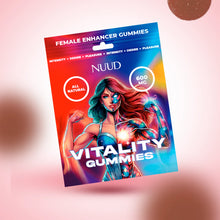
If external changes haven't moved the needle, it's because they're not designed to. What Tribulus Terrestris does, documented in controlled research, is engage the desire pathway biochemically. NUUD Vitality Gummies include Tribulus Terrestris, Muira Puama, Boiled Rehmannia Root, Piper Nigrum, and the NUUD Mushroom Complex, formulated specifically for this pathway. Not a confidence boost. A biochemistry intervention. Worth trying when you've been told the problem is you, and it isn't.
Frequently asked questions
Can weight loss improve libido?
It can improve overall wellbeing, which has indirect effects. But body weight alone is not a driver of sexual desire. A study following midlife women over multiple years found that baseline body weight did not predict desire levels (Nackers et al., Menopause, 2015; PMID 25803669). One review found that weight loss produced short-term improvements in composite sexual function scores, but the effect on desire specifically was not statistically significant at six months (PMID 34522491). Desire is primarily determined by hormonal and neurological factors, not physical size.
Why do I have low libido even though I feel good about my body?
Libido runs on a separate system from self-image. Your HPA axis, cortisol levels, and hormonal substrate determine desire regardless of how you feel about your appearance. Women with clinically diagnosed low sexual desire show measurably different cortisol patterns compared to women without the diagnosis, including flatter diurnal cortisol slopes and lower DHEA levels (Basson et al., Psychoneuroendocrinology, 2019; PMID 30909007). That is a chemistry difference, not a confidence difference. Feeling good about your body is genuinely valuable, but it doesn't reach the biochemical substrate that desire requires.
What is responsive desire and do I have it?
Responsive desire means desire that emerges in response to the right conditions, rather than arising spontaneously on its own. It's a documented, recognized pattern, not a dysfunction. Basson's foundational research (Journal of Sex and Marital Therapy, 2000; PMID 10693116) established that many women, particularly in established relationships, experience desire this way. If you rarely feel desire "out of nowhere" but can feel it when the right conditions exist, you likely have responsive desire. The internal conditions need to be in place first.
What actually helps low libido if external fixes don't?
Addressing the biochemical roots: cortisol management, hormonal evaluation with your doctor, sleep quality, and botanical support targeted at the desire pathway. Tribulus Terrestris improved desire scores significantly in a double-blind, placebo-controlled trial in women with low desire: 7.5 mg per day for four weeks produced statistically significant FSFI desire domain improvement compared to placebo (Akhtari et al., Daru, 2014; PMID 24773615; p < 0.001). These are mechanisms. External changes are not.
Is low libido a sign something is wrong with me?
No. It is a sign your internal chemistry is off, which is a common and biochemically explainable state. The self-blame that follows the "I did everything right and it didn't work" experience is understandable but clinically inaccurate. Desire is not a rating of attractiveness or effort. It is a function of hormones, cortisol, and neurological circuitry. Body dissatisfaction does correlate with reduced desire, but the mechanism is cognitive intrusion, not physiology (Quinn-Nilas et al., Sexual Medicine, 2016; PMID 27036088). The problem is addressable at its actual source.
*These statements have not been evaluated by the Food and Drug Administration. This product is not intended to diagnose, treat, cure, or prevent any disease.
If the weight came off and the wanting still has not, natural arousal support from plant botanicals is a different lever to pull.
